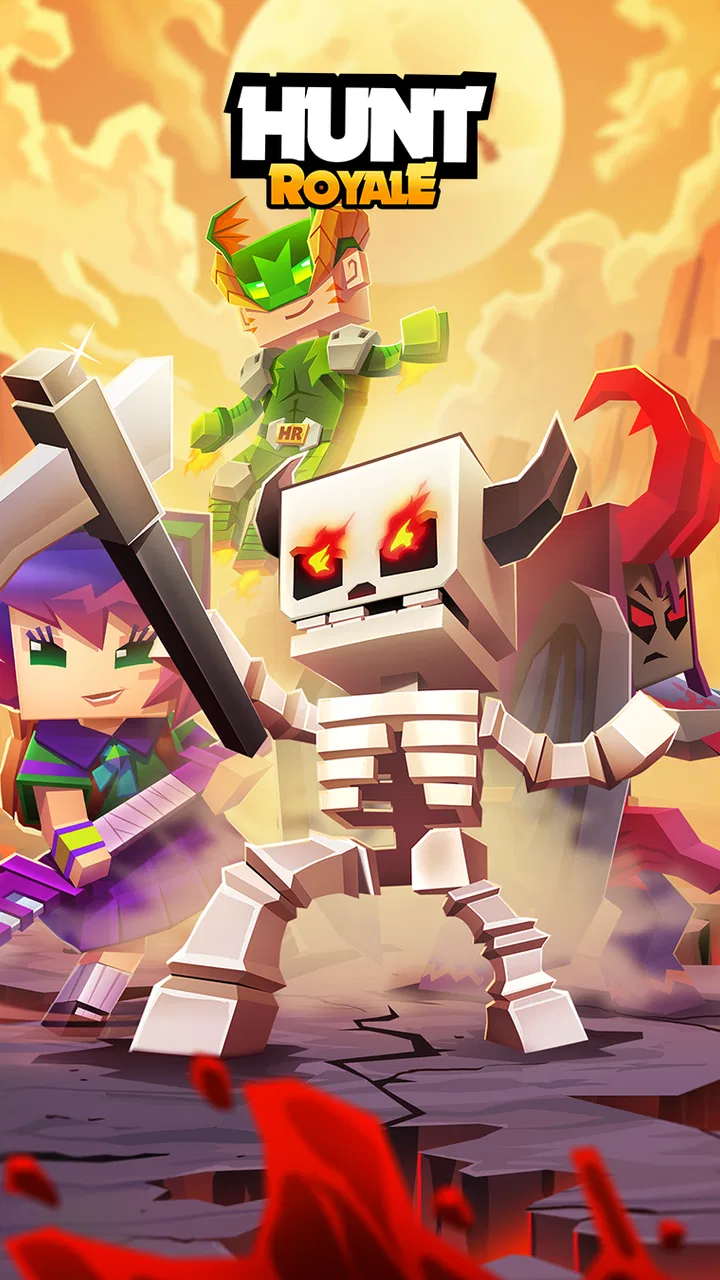
Hunt Royale: Action RPG Battle
- 4.3
- Rating
- 5.00M
- Installs
- Free
- Price

 Analysis by App-foxy
I spent time with Hunt Royale as a quick, combat-focused action game, and my first impression was that it understands the appeal of short sessions. You choose a warrior, enter a dangerous arena, defeat monsters, and deal with other players while trying to survive long enough to come out ahead. That basic loop is easy to understand, but it becomes more interesting once you start paying attention to positioning, timing, and the strengths of each character instead of simply rushing toward the nearest enemy.
Developed by BoomBit Games, this free-to-play action title is available for Android users running version 8.0 or later. It has built a sizeable audience, with more than five million installs, an average rating of 4.3 from roughly 193 thousand ratings, and about 8.4 thousand written reviews. Those figures suggest that the game has found a dependable audience, although popularity alone does not guarantee that its particular mix of arena combat and progression will suit everyone.
How the free entry point translates into value
The most important cost detail is straightforward: the game is free to download and play. That makes it easy to test without committing money first, which matters here because the appeal depends heavily on whether you enjoy repeated arena battles rather than a single long adventure. The game also contains in-app purchases ranging from $0.99 to $499.99 per item, so the free starting point should not be confused with an entirely purchase-free experience.
You May Also Like

 Blood Strike: 2.5 Anniversary
Blood Strike’s Loadouts Turn Every Drop Into a Tactical Gamble
A close look at Blood Strike’s custom loadouts: how fast access to signature weapons reshapes its battle royale rhythm, rewards preparation, and narrows the gap between fights.

 Pandora - Music & Podcasts
Pandora’s Music Is Easy to Start, but Harder to Recover
Pandora’s strength is its low-effort path from a seed to a station. Its weak spot is how much confidence it asks you to place in connection, setup, and quiet recovery.

 8 Ball Pool
 Is Built on Rivalries, Rematches, and Routine
A close look at the rivalries, rematches, shared routines, and unanswered safety questions that turn a quick pool match into a persistent mobile community.

 Samsung Music
’s Quiet Strength Is Playing What You Already Own
Its reach comes less from spectacle than from dependable access to a personal library. That simplicity is both the app’s strongest retention engine and its ceiling.

 AccuWeather: Weather Radar
AccuWeather Review: A Quick, Clear Forecast for Everyday Decisions
For everyday plans, the best forecast is the one you can understand quickly. AccuWeather makes rain timing, radar, and local conditions easy to act on, with a few trade-offs.

 Hill Climb Racing
Why Hill Climb Racing Still Turns Crashes Into One More Run
A tiny car, a bumpy hill and one more upgrade: Hill Climb Racing keeps resurfacing because its simple chaos makes every near-miss feel personal.
More From Our News Desk
View All News


I see that pricing structure as a reason to treat the game like a trial rather than an automatic bargain. You can begin without paying, learn how the combat feels, and decide whether the progression is enjoyable on its own. If you dislike the basic rhythm after several matches, spending money will not change the fact that the central experience is built around repeated fights. On the other hand, if you like improving a roster and returning for another attempt, the free access gives you room to judge the game properly before considering any optional purchase.
The age rating is Everyone 10+, which places it in a reasonable range for younger players who enjoy action games, though parents should still remember that optional purchases are present. I would personally enable purchase controls on a shared device, especially because the available item range reaches from small impulse amounts to a very high maximum. That is not a reason to reject the game, but it is a reason to decide on a spending limit before playing rather than making that decision in the middle of a tempting progression moment.
There is also a practical advantage to the free model: it works well for people who want a game to fill small gaps in the day. I can imagine opening it while waiting for an appointment, playing a few encounters, and closing it without needing to reserve an entire evening. The trade-off is that a session-based design can encourage “one more match” behavior, so the same convenience that makes it accessible can also make it easy to lose track of time.
The combat loop rewards restraint more than button mashing
The most satisfying part of the game is the tension between hunting monsters and watching for human opponents. Monsters give you an immediate target and help create momentum, but other players change the risk of every decision. Moving toward a reward may put you in a better position, or it may expose you to someone who has been waiting for exactly that opening. I found that the best results came from treating the arena as a space to read, not just a place to attack.
A useful habit is to avoid spending every attack as soon as it becomes available. Holding back for a moment can preserve an escape option or let you punish an opponent who commits too aggressively. This is one of the less obvious strengths of the game: even when the controls feel simple, the timing of an attack often matters more than the number of actions you perform. Players coming from fast arcade games may initially overextend because the monsters look like easy targets.
Another practical tip is to separate “safe progress” from “greedy progress.” If you have already gained a useful advantage, chasing one more enemy can be unnecessary. I learned to ask whether the next target improves my position enough to justify the exposure. That small change in thinking makes the matches feel less random and gives defensive play a real purpose. It is especially helpful when several threats are close together and the arena starts to feel crowded.
The game is also more approachable when you learn one character at a time instead of switching constantly. A new warrior can make familiar encounters feel different, but changing too often makes it difficult to understand why a defeat happened. I recommend choosing a character whose attack pattern feels comfortable, then concentrating on movement, spacing, and favorable engagements before trying to master a more demanding option.
Progression gives the short matches a reason to continue
Without some form of longer-term motivation, arena fights can become disposable. Hunt Royale avoids that problem by making each encounter part of a broader improvement process. You are not only asking whether you won the current battle; you are also learning which choices help you survive and which mistakes repeatedly cost you an opportunity. That makes a short session useful even when the result is disappointing.
The best way to approach progression is to treat losses as information. If you repeatedly fall while pursuing enemies, the lesson may be about patience rather than damage. If you lose during close-range exchanges, you may need to improve your approach to timing and distance. This mindset keeps the game from becoming a simple win-or-lose test and is one reason I think experienced action players will extract more value from it than people who only want instant victories.
There is a trade-off, though. Players who prefer a carefully scripted campaign may find the repeated arena structure less satisfying. The game’s value comes from refining decisions across many encounters, not from moving through a story with a clearly staged ending. If your ideal mobile action game is a one-time adventure with cinematic progression, this is probably the wrong direction. If you enjoy systems that become more readable through repetition, the format makes more sense.
What makes it different from ordinary mobile action games
Compared with a traditional beat-’em-up, the game places more emphasis on survival and confrontation with other players. A conventional action title often lets you focus on enemies arranged by the designer, while here the presence of other warriors adds uncertainty. You must consider not only whether you can defeat a monster, but also whether another player will arrive while you are weakened or distracted.
Compared with a long role-playing game, it is much easier to pick up for a short break. You do not need to remember a complicated story before starting a match, and the arena creates an immediate objective. The cost of that convenience is depth of a different kind: the game may not provide the same sense of exploration, narrative discovery, or world-building that a larger role-playing adventure offers.
It also differs from a purely competitive arena game because monsters remain part of the pressure. That creates a useful middle ground. You have something to do while assessing the situation, but you can never become completely comfortable because another player may turn the encounter into a sudden fight. In my experience, that mixture produces more varied decisions than a mode where every second is spent directly attacking an opponent.
Small-session use is a genuine strength
A realistic everyday use case is a commute or lunch break where I have enough time for a few focused matches but not enough attention for a large open-world game. I can start a round, make decisions quickly, and stop when the break ends. The game suits that situation better than a slower role-playing title that punishes interruption or requires a long setup before anything meaningful happens.
It can also work for players who like alternating between relaxed and competitive moods. When I want something calmer, I can focus on monsters and practice movement. When I want more tension, I can take greater risks around other players. That flexibility is valuable because it lets the same basic game serve different energy levels, although the competitive side can become frustrating if I am already tired or looking for something completely casual.
One advanced habit I recommend is reviewing the reason for a defeat before immediately starting again. Was the problem a poor target, a mistimed attack, or a failure to notice a second threat? Naming the mistake gives the next match a specific goal. This is more effective than simply playing faster, and it helps prevent the common cycle of repeating the same aggressive decision while expecting a different result.
Where the experience can lose its appeal
The biggest limitation is repetition. The game’s structure is designed around returning to arenas, fighting, surviving, and improving. That can be compelling when the combat is clicking, but it can also feel circular if you need constant new environments or a strong narrative reason to continue. I would not recommend it to someone who quickly tires of replaying similar types of encounters.
The free-to-play design is another point to watch. Free access is genuinely useful because it lets you evaluate the game without paying, but the presence of purchases means players must manage their own boundaries. The wide price range makes this especially important. I would only consider spending after deciding that the core game already provides enough enjoyment without payment; otherwise, a purchase risks trying to solve a problem that is really about personal fit.
Competition can create uneven emotions as well. A close defeat can be exciting because it shows exactly what you could improve, but repeated losses may feel discouraging if you prefer a relaxed power fantasy. The survival format naturally rewards caution, and players who rush into every fight may feel that the game is unfair when the real issue is overcommitment. It asks for adaptation, which is rewarding for some people and tiring for others.
Device compatibility is fairly accessible because the minimum requirement is Android 8.0, but that does not automatically mean every older phone will feel equally comfortable. Action games benefit from responsive input, and any delay or cramped screen can make timing harder. I would test the controls during the free portion before making a purchase, especially if the device is older or if I usually play with one hand.
Who will get the most from it
I think the strongest audience is made up of players who enjoy compact action matches, learning through repetition, and making risk-based decisions. It is a good fit if you like the idea of fighting monsters while staying alert to other players, and if you appreciate a game that can be played in short bursts without requiring a long narrative commitment.
It is also suitable for someone who wants to experiment with different warriors but is willing to learn them gradually. The game is more rewarding when character choice becomes a strategic decision rather than a cosmetic one. Take time to understand how your selected warrior handles pressure, when to disengage, and which targets are worth pursuing. That approach creates a clearer sense of progress than simply changing characters after every defeat.
I would be more cautious about recommending it to players who want a fully offline-style experience, a fixed campaign, or a purchase that removes all uncertainty about future spending. The free entry is a strong advantage, but the optional purchase structure means it is better suited to people comfortable with setting limits. Likewise, anyone who dislikes competitive pressure may prefer a calmer action game with predictable enemy patterns.
My verdict after weighing the free access and the friction
Hunt Royale: Action RPG Battle is worth trying because the free entry point makes the decision low-risk, and its combination of monster hunting, survival pressure, and player encounters gives short mobile sessions more tension than a routine action game. I especially like the way cautious movement and target selection matter. The game rewards players who observe before attacking, which adds meaningful strategy beneath its approachable surface.
I would not call it an automatic recommendation for everyone. Its replay-focused structure can become repetitive, competitive defeats can wear down casual players, and the purchase range requires sensible boundaries. The right question is not whether the game is free to start, but whether you enjoy the core loop enough to keep playing without feeling pushed to spend. If the answer is yes, the free version offers a fair way to explore its value before making any optional decision.
My final advice is simple: install it for the short-session combat, choose one warrior to learn properly, and judge the experience by how much you enjoy improving rather than by a single early result. If you want a quick action game with real player tension and room for careful decision-making, BoomBit Games has made a convincing option. If you are looking for a story-heavy adventure or a completely frictionless casual game, I would skip it and choose something built around those priorities instead.
FAQs for Hunt Royale: Action RPG Battle
01What kind of game is Hunt Royale: Action RPG Battle?
Hunt Royale is a fast-paced multiplayer action RPG that combines dungeon crawling, character progression, and competitive battles. You choose a hunter, enter short combat-focused matches, defeat monsters or opposing players, collect rewards, and improve your abilities. Its bite-sized sessions make it suitable for mobile play, while the variety of hunters and game modes adds more depth over time.
02Can Hunt Royale be played offline?
Hunt Royale is primarily designed as an online game, especially for multiplayer modes, seasonal content, rankings, and reward systems. Some parts of the experience may load without a stable connection, but you should not expect the complete game to work offline. A reliable internet connection is recommended to avoid matchmaking problems, synchronization errors, or lost progress during active sessions.
03Is Hunt Royale free to download and play?
Yes, Hunt Royale can generally be downloaded and played for free on supported Android and iOS devices. However, it includes optional in-app purchases that may provide gems, bundles, cosmetic items, progression resources, or other conveniences. You can make progress without paying, but unlocking and upgrading hunters may require more time if you choose not to purchase optional content.
04Does Hunt Royale support multiplayer and cooperative gameplay?
Multiplayer is one of Hunt Royale’s main features. Depending on the available mode, you can compete against other players, participate in team-based activities, or work cooperatively while fighting monsters and completing objectives. Matchmaking and mode availability can change with updates, so the exact experience may vary. An internet connection and a compatible account are normally required.
05Are there many hunters and progression options in Hunt Royale?
The game offers a broad selection of hunters, each with different attacks, abilities, strengths, and preferred playstyles. You can upgrade characters, experiment with equipment or abilities, and adapt your strategy to different enemies and modes. Progression is not only about increasing power; learning when to use each hunter’s skills is important for surviving difficult stages and succeeding in competitive matches.
Pros
- Fast
- engaging battles that work well for short gaming sessions.
- Wide variety of heroes with distinct abilities and playstyles.
- Cooperative modes add teamwork and replay value.
- Simple controls make the game easy to learn on mobile.
- Frequent rewards encourage regular play and progression.
Cons
- Progression can feel slow without spending money or grinding.
- Some battles may feel unbalanced between upgraded and new players.
- Energy or time-based limits can interrupt extended sessions.
- The interface can feel crowded with currencies and upgrade menus.
- Online matchmaking and connection issues may affect some matches.

Hunt Royale: Action RPG Battle
Gallery